THE UNBEARABLE LIGHTNESS OF “TECNOFEUDALISM”. An erratic label that vanishes into thin air
This essay aims to critically unravel the particularities of the expression 'technofeudal'—both from its intended role as an analytical category and from its elevation to a supposed 'theory' that, according to its creator and stealthy followers, would be useful not only to reliably describe the current economic-political moment of global capitalism, but also as a solid framework that would make it possible to 'forecast' (or 'predict'?) the features of, and the transition toward, a new post-capitalist society in the near future.
However, one step was not taken—a step that must be taken if one does not wish to be complicit in the most profound and serious denial of the sciences of matter, life, and humanity. And of humanity itself. The step that was not taken—and that is needed with the utmost seriousness—consists of including the category of capitalism as a rigorous scientific concept, associated not only with the law of value but also with the law of the production and reproduction of life…
Pablo González Casanova, The Dangers of the World and the Forbidden Sciences (2017)
Recently, the term “techno-feudalism” has gained popularity, gradually entering the lexicon of academic and political discussions that are currently attracting considerable attention. It is a label propagated by various analyses, including those that self-proclaim themselves as critical and that strikingly span the spectrum of so-called progressivism—which, strictly speaking, should neither be conflated with nor confused with leftist perspectives.
On the one hand, these analyses have sought to characterize the current state of the global economy by highlighting the effects of an erratic capitalist “Fourth Revolution,” emphasizing the “advances” in information technologies in general and the misnamed “Artificial Intelligence” in particular. On the other hand, the term “techno-feudal” has also been used to anticipate the future of today’s political economy, foreshadowing a sort of final and definitive transition toward a supposedly unprecedented mode of social (re)production that goes beyond capitalism. This transition is presented as “imminent” and is said to consist of a kind of prospective regression toward a new type of feudalism, prefixed with “techno” as a way to reinforce the idea of the novelty of this cryptic emergence.
This essay aims to critically unravel the particularities of the term “technofeudal,” both in terms of its purported status as an analytical category and its elevation to a supposed “theory” that —according to its own creator and his secretive followers—would be useful not only for plausibly describing the current economic and political moment of global capitalism, but also as a solid framework that would allow for “forecasting” (“predicting”?) the characteristics and transition toward a new post-capitalist society in the near future. Although several analysts have already subjected the prominent gaps in the techno-feudal narrative to various critical examinations (e.g., John Bellamy Foster, Michael Roberts, Evgeny Morozov), it is
necessary to revisit several key points of discussion on this topic that still require more detailed analysis.
Given that the subject requires analytical rigor, this article is divided into four sections.
The first part, “Why ‘Techno-Feudalism’?”, summarizes the emergence of this category and some of its main features and references.
The second part, “WhyNot‘Techno-Feudalism’? A Thesis on Its Unbearable Lightness,” aims to reveal the unsustainable lightness of this purported category, especially at the theoretical level. The systematic documentation of this label’s weaknesses necessarily undermines its analytical robustness, whether in formulating diagnoses or projecting prognoses—especially regarding an issue as crucial as it is pivotal: the (supposed) end of capitalism and the consequent “dissolution” of its dynamics. This second section will therefore discuss the categorical nature of “techno-feudalism” in the conceptual sense and how, by omitting even the most basic epistemological rules, the techno-feudal “hypothesis” amounts to an expression that may sound impressive but is ultimately trite, trivializing current realities from the outset while also disregarding the necessary historical and social articulation required of any conceptual idea. This would explain why envisioning a “prospective return” from capitalism to feudalism turns out to be not only a surreptitiously licentious fantasy but also a proposition that is theoretically inconsistent, sociohistorical incoherent, and logically incongruent.
Given the vagueness of the label “techno-feudal,” it is also necessary to point out that its implications are not merely abstract in terms of our understanding of current realities. Fundamentally, this particular label would also have political implications for the recognition, development, and status of the class struggle as it exists today.
The last two sections—“Rent-Seeking (Ephemeral) and the (Unassailable) Law of Value (III)” and “The Mystery Behind ‘Techno-Feudalism’: Neoliberalism in Our Time (IV)”—focus on the political deviations inspired by techno-feudalism and the need to restore, within this type of analysis, the value of the critique of political economy. For if there is one thing that characterizes techno-feudal “theses” / “hypotheses” / “theories,” it is the total failure to treat the category of capitalism “as a rigorous scientific concept” with the utmost seriousness—echoing the point made by Pablo González Casanova.
I. WHYTECHNO-FEUDALISM?
Two relatively well-known figures active in the political and intellectual spheres of European public opinion are responsible for popularizing the term “techno-feudal.”
The first is Yanis Varoufakis, a Greek-Australian economist and the central figure of the European Front for Realistic Disobedience (ΜέΡΑ25, by its Greek acronym). As Greece’s Minister of Finance during the Syriza government in 2015, he was one of the most prominent figures amid the deepening crises in the eurozone and the sovereign debt crises, particularly in Portugal, Italy, Ireland, Greece, and Spain ( , known by the derogatory acronym “PIIGS” in English). In that context, Varoufakis led the criticism of the economic directives issued by the Troika (the European Commission, the European Central Bank, and the International Monetary Fund) and the imposition of neoliberal austerity programs, particularly on Greece.
In 2024, Varoufakis published Techno-Feudalism: What killed Capitalism, a work he considers “(…) to fit perfectly within the Marxist political-economic tradition,” noting in passing: “I wrote it as part of Marxist scholarship.” (see Varoufakis, 2024b)
In Techno-Feudalism, Varoufakis asserts that during the period between the global shock of 2008 and the global pandemic of the third decade of this century, on the one hand, “(…) the traditional dynamics of capitalism no longer govern the economy” and therefore “what has killed this system is capital itself and the accelerated technological changes of the last two decades”; and, on the other hand, that the “two pillars on which capitalism rested have been replaced: markets, by digital platforms that are veritable fiefdoms of Big Tech; profit, by the pure extraction of rent.” Thus, according to the self-declared “theory” proposed by Varoufakis, then:
(…) capitalism is dead, in the sense that its dynamics no longer govern our economies. That role is now played by something fundamentally different, which I call “techno-feudalism” … what has killed capitalism is… capital itself. Not capital as we have understood it since the beginning of the industrial era, but a new form of capital—a mutation that has emerged over the last two decades, far more powerful than its predecessor and which, like a mindless, hyperactive virus, has destroyed its host. What were the causes? Two key factors: 1) the privatization of the internet carried out by the major U.S. and Chinese tech companies; and 2) the way in which Western governments and central banks responded to the great financial crisis of 2008.
(Varoufakis, 2024a, p. 7).
The second proponent of the techno-feudal idea is the French economist Cédric Durand, who serves as a professor at the School for Advanced Studies in the Social Sciences and is also a researcher at Paris Nord.
In 2020, Durand published: Techno-féodalisme. Critique de l’économie numérique, in which he argued that we are witnessing not merely changes, but genuine “qualitative” transformations in contemporary capitalism that center around a process of “feudalization.” Essentially, the trends toward feudalization in capitalism can be explained by the aggressive and profound monopolization of knowledge by Big Tech. In other words, the hoarding and concentration of data, algorithms, information, and digital services in general through predatory practices leads, on the one hand, to the existence of a sort of techno-feudal lords and, on the other, to a digital serfdom (see Durand, 2025), which would allow us, within this “parallelism,” to speak of a techno-feudal era.
Thus, Durand’s techno-feudal “hypothesis” would be justified by “the relevance of the notion of feudalism in accounting for certain [sic] current economic trends,” since, according to this author, “the specters of feudalism are innumerable,” enabling these analogies to characterize a newly minted feudal phase.
However, for Durand, the central issue of this configuration—which is assumed to be “unprecedented”—lies in the fact that
The political economy of the digital realm, in my opinion, depends primarily on the issue of rent… the rise of intangibles upends that classical logic (…) This attachment disrupts competitive dynamics and offers those who control the intangibles an unparalleled capacity to appropriate value without truly engaging in production. What then prevails is a relationship of capture. In this configuration, investment is no longer directed toward the development of the forces of production but rather of the forces of predation.
[emphasis in the original text] (Durand, 2021, pp. 120–121)
Although Durand’s argument is, in principle, less inconsistent than Varoufakis’s version, the discussion will henceforth revolve to some extent around Varoufakis’s concept of techno-feudalism, because while this position is the most problematic, it also appears to be the most widespread due to its propagandistic impact on the debates.
In “the strange hypothesis”—as Varoufakis himself recounts in the preface to his work—according to which “capitalism was disappearing (and not undergoing one of its many impressive metamorphoses),” we must begin by noting a situation that, however anecdotal it may seem, points precisely to the seriousness and rigor with which techno-feudalism—supposedly a “theoretical” category with all that this implies—is surprisingly “underpinned.”
Varoufakis sets this out directly and explicitly in the final section of Technofeudalism, subtitled “Influences, Readings, and Acknowledgments”—a section that readers often treat as footnotes with marginal content compared to the more substantial arguments within the main body of the text and therefore tend to skip over— but where he states unequivocally:
(…) Readers who know me a little won’t be surprised by the reference I’m about to make to Star Trek. Believe it or not, the term “cloud capital” comes from the twenty-first episode of the third season of the original series, titled “The Guardians of the Cloud,” which originally aired on February 28, 1969. Written by Margaret Armen (based on a story by David Gerrold and Oliver Crawford), the episode takes place on Ardana, a planet where a ruling class lives in luxury in Stratos—a city that floats motionless above the planet’s clouds. Meanwhile, all the work is done on the planet’s surface and in underground tunnels. This work is carried out by the troglytes, whose minds are constantly intoxicated by a harmful gas that dulls and stupefies them. I could not resist the temptation to make the leap from the “Guardians of the Cloud” in Star Trek to the “cloud capital” of techno-feudalism.
(Varoufakis, 2024a, pp. 280–281)
This is a key statement that should not go unnoticed in arguing WhyNot“Techno-Feudalism” and in articulating the Theses on Its Unbearable Lightness.
II. WHYNOT“TECHNO-FEUDALISM.” Theses on Its Unbearable Lightness.
The first part of this reflection highlighted how Varoufakis confessed that he could not resist the temptation to interpret the crucial transition from capitalism to techno-feudalism using—as a key reference—a chapter from the American TV series Star Trek! Varoufakis elevates this television series, incidentally, to the status of the “humanist communist manifesto of our times,” containing a “materialist theory of history” within what he would call “libertarian communism” [libertarian communism] (Varoufakis, 2025a).
For Varoufakis, the crucial transition toward techno-feudalism has already been consummated and is not merely a possibility: “in the 10 years since the 2008 crisis,” we are already witnessing a world beyond capitalism—a post-capitalist era! (which has “returned” us to “our former condition as serfs” (Varoufakis, 2024a, p. 74). Thus, the so-called “techno-feudal ‘hypothesis’” has already been validated by verification, becoming a thesis—a “theory.” However, contrary to Varoufakis’s self-aggrandizement, what we have here is not a theory in the scientific sense of the term, but rather a theoretical construct that is, moreover, flawed, inconsistent, and far too erratic. Let’s take a closer look.
Rather than drawing inspiration from the concrete facts of real, actual history, Varoufakis starts from a re-presentation of reality rather than Reality itself. In scientific inquiry, it will always be possible to turn to aesthetic expressions—literature or film, and in this case a well-known television series; Chaplin’s Modern Times or the metaphorical devices found in Marx’s Capital are prime examples—since the symbolic dimension is useful for illustrating situations and can serve as a pedagogical and didactic tool in helping to understand events and describe social structures. But in this case, the strange maneuver Varoufakis employs turns everything upside down. In no way can his imagery serve as a basis for deriving a theory from knowledge. Varoufakis takes the aesthetic dimension as a point of reference in and of itself (as Lukács put it), preventing logical reasoning from proceeding from actual reality toward expression or representation in order to then propose an image that (re)signifies it. Quite the opposite. He does not illustrate how capitalism might be re-presented in what happens in Star Trek (or in his hesitant references to other films like The Matrix); rather, Varoufakis focuses on the series and its cinematic plots—and we must emphasize: a detail that belongs to mere representation—to draw grandiose conclusions about actual reality. Varoufakis does not move from the “abstract to the concrete”; rather, contrary to Marx, he moves from “the abstract to the fictional” and thereby draws “conclusions” that are all too grandiloquent: the end of capitalism as a mode of social (re)production, asserting the imminent transition to “techno-feudalism.” As Marx once aptly noted: Who could say that a self-portrait is the artist himself!
Although Varoufakis presents his positions as part of the Marxist tradition, in the case of techno-feudalism, this pseudo-analysis always runs counter to Marx.
By preferring fictional “stories” over concrete “History,” Varoufakis refuses to delve into “the foundation of life,” which is what theory seeks in terms of historical materialism. Here, the postmodernist stench proves to be inevitable. It distorts (scientific) theory into pure (subjectivist) theorizing and ultimately embodies it around “techno-feudalist” delusion. The techno-feudal profile seems to stem from the legacy of the most vulgar form of postmodernism , in that it claims that reality is altered by changing the terms used to describe it—precisely, and by analogy, the effect Varoufakis seeks when he draws on a television series to interpret the evolution of capitalist society in the 21st century. This is a trait that M. Roberts had already noted when he described Varoufakis as an “erratic Marxist.” However, rather than erratic, Varoufakis is plain and simple anti-Marxist! The meandering, thoughtless arguments that attempt to convince us of “techno-feudalism” are quite far removed from—if not outright contradictory to—the intellectual legacy of Marx (and Engels, at the very least).
In the superficial—to say the least—treatment of techno-feudalism, there is a host of inconsistencies. However, there are several issues that deserve to be highlighted.
First, because techno-feudalism—whether it purports to be a “theory” or even a “hypothesis,” in any case fallacious—in Varoufakis’s version fails to meet the minimum standards of meaning required to formulate a concept or category with scientific characteristics; that is, a construction based on systematic thought that allows for the description, understanding, and above all, explanation of a fact as momentous as the “end of ends” of capitalism. No matter how much one might wish to imagine a “return” of feudalism with the prefix “techno,” Varoufakis overlooks something fundamental and widely recognized in scientific practice: concepts are intimately associated with their respective socio-historical reference systems. Or, in other words, any concept (from categories to fundamental definitions) must be theoretically consistent, logically coherent, and empirically congruent—such as Einstein’s concept of spacetime or its equivalent in the social sciences: Marx’s socio-historical formations. Nowhere in this pseudo-argument does Varoufakis verify to what extent the trends—the “laws,” which in this case are always tendential—in capitalist relations have definitively vanished, nor how (techno)feudal relations have emerged from this established fact. This line of reasoning neglects what Pablo González Casanova recommended: to include the category of capitalism as a rigorous scientific concept, associated not only with the law of value but also with the law of the production and reproduction of life; for, as seen in the development of , Varoufakis represents the exact opposite.
In the General Introduction to the Critique of Political Economy (1857), Marx clearly outlined the theoretical-methodological path that would confirm why “techno-feudalism” as a rigorous category simply vanishes into thin air:
(…) the correct scientific method. The concrete is concrete because it is the synthesis of multiple determinations—and thus the unity of the diverse. It appears in thought as a process of synthesis, as a result, not as a starting point, even though it is the true starting point, and, consequently, the starting point as well for intuition and representation. In the first approach, full representation is volatilized into an abstract determination; in the second, abstract determinations lead to the reproduction of the concrete through the path of thought. This is why Hegel fell into the illusion of conceiving the real as the result of thought which, starting from itself, concentrates on itself, delves into itself, and moves by itself…
(Marx, 1857, p. 40)
The (techno)feudal thesis, in addition to showing little imagination—in the sense claimed by Wright Mills: sociological imagination—deludes itself retrospectively with a “return” to feudalism without even attempting a novel configuration.
Varoufakis’s venture does not even touch upon—here, indeed, in the Marxist tradition—Engels’s so-called “second edition of serfdom.” There, he analyzed how, during the historical transition from feudalism to capitalism, certain areas of Eastern Europe (more precisely, east of the Elbe; peripheral and “backward” territories compared to the “western” ones, which at that time were breaking away from “evolved” feudalism toward the “progress” promised by Capital) exhibited a “strengthening” of the former. Had he explored Engels’s analysis linking the feudal “returns” that Varoufakis seeks to force, he would have realized that the aforementioned “strengthening” of feudal conditions was merely an apparent phenomenon and not a robust social condition that would lead one to interpret a “new feudalism” existing in parallel with the capitalist system. The feudal revival identified by Marx and Engels would therefore prove to be ephemeral, albeit historically necessary. It was a “complementary” process and part of the development of the (nascent) capitalist mode of production; in this sense, it was not only subordinated to but also “functionalized” by the logic of Capital.
(…) The emergence of the “second serfdom” —along with its root causes, its distinction from the evolved feudal economy in Western countries, but also the relationship and complementary nature that, for them, arises from the “second serfdom,” and the question of whether this is not rather a phase toward capitalism rather than a mere “resurgence” of classical feudal relations; these are the main elements on which we can focus this rich body of issues.
(Various Authors, 1980, p. 6)
The reappearance of (feudal) serfdom in Marx and Engels (who first used this term) was explained, then, from within the historical social framework to which this phenomenon belonged: capitalist society; not from outside it (as turns out to be a misguided approach in the theoretical approach practiced by Varoufakis).
Another analogous historical situation that reveals the absurdities of so-called “techno-feudalism” could be illustrated by the case of slavery in Latin America and the Caribbean—and especially in the United States. No one with a theoretically consistent framework—much less anyone seeking to adopt an approach grounded in historical materialism—would ever think to assert or even argue that plantation slavery in the southern United States during the 19th century justifies the conclusion that the United States underwent a transition from a colonial economy to a “return” to the slave mode of production. In fact, one could even argue that, in the Southern states of the United States, agriculture depended on slave labor (primarily African and African American), but that there were also forms of servitude which, by contrast and in comparison with the slave plantations producing tobacco, sugar, and especially cotton, were in the minority.
By analogy with the examination of (techno)feudalism, in the case of American slavery, one need not delve into Marx’s analyses on the subject (such as The Civil War in the United States, the “Message to the National Labor Union of the United States” or the letters referring to this topic, including the one addressed to Abraham Lincoln, as President of the United States of America, originally published by The Bee-Hive Newspaper on January 7, 1865) to know that, in the slavery of the American South, “(…) direct slavery is the basis of bourgeois industry” and that “Without slavery there would be no cotton; without cotton there would be no modern industry. Slavery has given value to the colonies; the colonies have created universal commerce; universal commerce is the necessary condition of large-scale industry,” as Marx proposed in The Poverty of Philosophy (1846). In other words, this slavery—correctly interpreted within its own space-time and properly situated within the historical social system of reference to which it belongs as a phenomenon—or, in other words, strictly adhering to the framework of “(…) a specific historical society,” as Engels would add in Anti-Dühring—is by no means a predominant “mode of production,” but rather “a linchpin of our current industrialism” (Letter from Marx to Pavel Vasilyevich Annenkov, December 28, 1846).
Whether in the example of modern slavery or to dispel illusions about “techno-feudalism,” it would suffice simply to leaf through the pages of Marx’s most exultant work. In fact, the vast majority of proponents of Marxist thought recommend beginning the reading of Capital with Chapter XXIV: “So-Called Primitive Accumulation” to realize that
(…) Liverpool grew rich thanks to the slave trade. This trade was its method of primitive accumulation… In 1730, Liverpool had 15 ships engaged in the slave trade; by 1751, there were already 53; in 1760, 74; in 1770, 96; and in 1792, 132. While introducing child slavery into England, the cotton industry served as a driving force to transform the more or less patriarchal slave economy of the United States into a commercial system of exploitation. In general, the veiled slavery of wage laborers in Europe required, as its foundation, slavery sans phrase [without reservation] in the New World.
(Marx, 1867/1867, p. 254)
Of course, it is clear when Marx uses the term “slavery” as a word to describe the situation of child labor in nineteenth-century England; when he uses that same term as a conceptual category to explain its role within the capitalist mode of production; and when, in other sections of this or his other works, Marx uses the term “slavery” in the conceptual sense of a predominant mode of production to refer to Achaean or Latin antiquity. To say, then, that “child slavery” was being established in England could not logically justify—much less historically extrapolate—that nineteenth-century England was “returning” to a “slave-owning” society. Well, operations of this kind—carried out haphazardly—are precisely what lie behind the ambiguous term “techno-feudalism.”
Secondly, Varoufakis’s proposal could easily be characterized as neocolonial due to the ethnocentrism—and more precisely, the Eurocentrism—to which it leads. Although this is a debate that has long since been settled, here a new, globalized form of feudalism is directly and capriciously universalized, without taking into account that feudalism was a phenomenon that arose, spread, and died out exclusively in Europe. This extrapolation would once again evoke the nineteenth-century colonial fixation of German Romanticism, according to which universal history unfolded irrevocably in a linear sequence (of Progress!) from antiquity, through the Middle Ages, and finally toward modernity (as Novalis and Hegel would have it; a classification also dear to Stalin), with all that this would imply ontologically and politically, bringing to the fore the Eurocentric perspectives on the Philosophy of History. Here, once again, Varoufakis’s anti-Marxism is dizzying. It must be remembered that Marx always criticized the simplistic nature of this type of pseudo-historical “approach”—or rather, “dead end.” In the “Kovalevsky Notebook,” Marx criticizes Kovalevsky for his obsession with “seeing” supposed feudalisms where they do not exist in Latin America or India, based on European feudal experience and synthesis—that is, in accordance with a colonialist and perspective.
But, setting aside philosophical speculations, does the term “techno-feudalism”—even in the “critical” (alway ) tone that Durand seeks to adopt or that Varoufakis aims to promote—suggest, then, that sociopolitical, socioeconomic, cultural, and other struggles in the near future would have to be waged under the imperative of overcoming the (techno)feudal condition and unfold within the framework of a kind of new techno-capitalist modernization, just as (strictly European) history has shown? In the face of “techno” feudalism, which is supposedly taking hold today, would the alternative be to “reconfigure” capitalism—albeit in a “techno” version? Is the alternative to the unreal and implausible techno-feudal lords, then, a renewed techno-bourgeoisie?
While these hypothetical relationships may seem absurd, they are nonetheless questions that arise from the (il)logical inertia derived from the pseudo-concept of “techno-feudalism,” which, as noted earlier, offers more (historical) fusions and (theoretical) confusions than (political) clarity for understanding the real world or for generating genuine alternative paths to transform it.
Here, incidentally, it becomes apparent that Varoufakis lacks a relational analysis. Instead, Varoufakis speaks from a subjectivist frenzy. Any Marxist knows that Capital is not made up of “things.” Nor can one think of it as “people” or even “subjects” confined to mere subjectivities, as seems to be justified when—suddenly, no less—supposed techno-feudal lords “appear,” which would automatically lead one to assert that “Capitalism” no longer exists! If Capital is a historical social relation, then it is absolutely necessary to go beyond reification and (solipsistic) subjectivism by discerning—as Marx did so carefully—between mere and simple personalizations and the complexity of personification in the reflection of societies in general and, in particular, those governed by Capital. That is why, when Marx asked, “To what does the original accumulation of capital—that is, its historical genesis—boil down?”, he first noted: “(…) it is not the direct transformation of the slave and the serf into a wage laborer, that is, a mere change of form…” ( ; an issue that Varoufakis’s analysis does indeed reduce to a problem that is fundamental, since, for him, we have regained “our former condition as serfs,” although he offers no proof or evidence of this other than the license afforded by his fanciful inspiration. Whether it is Durand or Varoufakis, rabid idealization is the irrevocable rule of their (proto)analyses.
At the heart of this matter—so heavily suspected of intellectual incoherence—lies, however, a higher “reason” to which Varoufakis turns to support his erroneous thesis on erratic techno-feudal post-capitalism. It is a matter of misunderstanding—precisely due to the lack of a theoretical t to guide his reflections—regarding the category of rent (in a Marxist sense, especially). For Varoufakis—and something similar occurs in Durand’s techno-feudal version—capitalism has simply and plainly become extinct, because
Markets, the medium of capitalism, have been replaced by digital trading platforms that resemble markets but are not, and which are better understood if we consider them fiefdoms. And profit, the engine of capitalism, has been replaced by its feudal predecessor, rent.
(Varoufakis, 2024a, p. 68)
Given their central importance, these types of misunderstandings must be carefully debunked; for this reason, they will be examined and discussed in the third part of this reflection.
III. (VAGUE) RENT-SEEKING AND THE (INCONTROVERTIBLE) LAW OF VALUE
All economists make the same mistake: instead of considering surplus value purely as such, they consider it through the particular forms of profit or rent…
Karl Marx, Manuscripts of 1861–1863.
Just as Marx denounced at the time in relation to political economy—and especially in relation to vulgar economics—the case of the techno-feudal “theory” conflates concepts and reifies social relations in a surprising form of subjectivism.
The primary intellectual flaw and the greatest theoretical shortcoming of the proponents of techno-feudalism is the lack of a plausible approach to the actually existing functioning of today’s society (and not just the “economy”), which is (still) unambiguously capitalist—especially when they attempt to “ground” this approach in a fallacious Marxist interpretation. Contrary to all the basic tenets of Marx’s thought—which precisely aims to unravel the foundation of the living and of real reality (as Marx habitually referred to it, and never in a tautological manner)—in his analysis of rent, Varoufakis omits—at least—two indispensable categories within Marx’s (and Engels’) diagnosis, without which it would be impossible to proceed: totality and exteriority. Both are indispensable analytical tools that are conspicuously absent from this pseudo-techno-feudal analysis, which is thus trapped in the superficiality of the superficial—in addition to the subjectivist bias noted earlier—by referring to specific situations (parts, situations) without relationally integrating the ontology of capitalism (the whole, the conditions, its tendencies). As Dussel (1988, p. 58) has rightly pointed out, it is through these key mediations that one can understand “the possibility of the original becoming of capital and of the critique of bourgeois political economy.” Standing at the antipodes of Marx and Engels’ thought, techno-feudal “(hypo)theses” take the part for the whole and, in any case, always navigate amid various ecological fallacies.
Indeed, when it comes to one of the “reasons” cited to support the purported transition and supposed consolidation toward a mode of social production different from the current one—techno-feudalism, the “stealthy” substitute for capitalism—Varoufakis notes: “the engine of capitalism has been replaced by its feudal predecessor , rent” ( . Thus, give or take a few words, arguments or pseudo-arguments, the question of rent would be one of the main “core issues” of this matter. Here, it is important to note a couple of points.
First, the assumption that “rent” is an eminently “feudal” category is an association that does not hold up to any logical or historical analysis. Beyond the absurdity of proposing that rent is a sort of “feudal predecessor,” what is revealed here is Varoufakis’s anti-historical, strongly Eurocentric (and, moreover, colonialist—as Sergio Bagú has pointed out), and obtusely substantivalism view on the matter. At the same time, what such statements reveal is Varoufakis’s ignorance of the workings not only of contemporary and historical capitalism but also his a priori simplification of the feudal phenomenon itself (a strictly European socio-historical phenomenon that is, moreover, complex). The historical blindness of Varoufakis’s analysis overlooks the fact that rent is shaped by the socio-historical systems of reference to which this phenomenon is transhistorical ascribed, and that, like capital, these realities and categories cut across different modes of production. The question, however, as Marx noted, is to determine when rent or capital prove to be dominant in the processes of production and reproduction of life (not just “the economic”) in this or that society (the notion of subsumption thus proves crucial in this approach). Restricting rent to a single type of society—one as exceptionally rare as feudalism (we emphasize: an exclusively European phenomenon)—is an unforgivable form of reductionism. It becomes an even more serious digression when one proposes a sort of dominant “return” to rent that would “govern” the new global neo-feudal social order.
Thus, Varoufakis is closer to Rodbertus—even to Fourier or Proudhon, who in their time coined the term “industrial feudalism” to refer to the phase of capitalism corresponding to the emergence of trusts and cartels! —and increasingly distant, certainly at the opposite end of the spectrum from Marx.
Second, by proposing that rent is the “feudal predecessor” [sic] of “profit” [sic; it should be noted that profit and gain are not the same thing!] they are also conflated, confused, and—even more seriously—other issues are omitted that not only have historical implications but also completely disregard processes that are truly real and effective for capitalism—the very same capitalism that, according to Varoufakis, is already extinct. The main theoretical implication of Varoufakis’s hermeneutic blindness is that it would nullify the law of value that “objectively” governs capitalist society—that is, the central (if not the primary) argument of the Marxist-Engelsian perspective—thereby challenging surplus value both as a concrete category and as an actual reality. Omissions of this kind reveal not only Varoufakis’s lack of understanding of the Marxist perspective but also demonstrate an ethical and political dereliction of duty. By failing to analyze current reality from the horizon of visibility (or the site of enunciation) of Labor—that is, from the perspective of the workers—an anti-Marxism is imposed, for
(…) Marx is concerned with defending the “law of value” because, ultimately, what matters is labor objectified in value—living labor: humanity itself. It is a fundamental ethical issue. Nor is rent an exception to the law that everything (surplus value, value, price, and profit) is ultimately grounded in living, human labor. Its inalienable dignity remains the rule. For this reason, it was important to define rent in terms of surplus value and to establish the necessary categories to set up the mediations that allow for an explanation of the phenomenon.
(Dussel, 1988, p. 160)
Of course, this is a debate as profound as it is extensive. For Marx, these controversies were the result of a genuine theoretical discussion that had been critically developed and refined over several years with thinkers of the stature of Anderson, Smith, and Ricardo. However, this debate could also be briefly illustrated through a few annotated passages intended to demonstrate, in general terms, the unfathomable theoretical void involved in upholding any form of techno(neo)feudalism.
Thus, for example, Varoufakis and the new fundamentalists of techno-feudalism seem never to have questioned what the (real) basis of rent in capitalism might be—the one that has ceased to exist, according to their capricious and unfounded belief—nor in the purportedly emerging techno-feudal world where rent is supposedly supposed to take precedence over profit [sic]. Nor do they seem to reflect on—much less realize—that, from a Marxist perspective, rent in capitalism is a form derived from surplus value itself! And that rent “in general”—as Marx demonstrated, especially in Capital—is unpaid labor, surplus value. In fact, in terms of the subjects/actors or personification / personalization of social relations, rentier capitalists are a fraction of the capitalist class! What seems to blur and confuse this techno-feudal misunderstanding is that, while rentier classes may be an unproductive class (and here we must bear in mind the theoretical definition of this term within the framework of Marxist explanation), this does not exempt them from being related to the capitalist mode of production. That is why Marx pointed out in the 1861–1865 Manuscripts:
The form of income and its sources express the relations of capitalist production in their fetishized form. Their existence, as it manifests on the surface, appears disconnected from the hidden connections and the intermediate links that serve as mediations. Land thus becomes the source of rent (6, 1450, 36–1453, 1; III, 403). In this expression, in which a portion of surplus value—rent—is represented in relation to a specific element of nature, independent of human labor, not only is the nature of surplus value completely obscured, but profit itself now appears, as ground rent, as attributable to capital (1484, 12–17; III, 430)
(cited by Dussel, 1988, p. 172)
One of the reasons that would account for the total lack of understanding—and more directly, techno-feudal theoretical blindness—and, ultimately, the unfolding of a set of ideas without any theoretical or historical foundation and therefore entirely unreal, is Varoufakis’s take on rent. This topic remains a veritable verborgnes Mysterium —as Marx put it— for techno-feudalism would find it inconceivable to conceive of competition among capitals—and especially the reality and explanatory category underlying this phenomenon: the transfer of values (not to be confused with the transformation of values into prices) through intra-capitalist competition, which is the mechanism that “regulates” the participation of fragmentary capitals in the surplus value and profit of global Capital. The following passage from Marx is certainly illuminating for understanding the logic behind this phenomenon:
Commercial capital creates neither value nor surplus value—that is, not directly. […] The profit that commercial capital obtains is only a portion of the surplus value created by productive capital as a whole […] which takes the form of capital, money, income, profit (interest), rent, and wages […]—a transfer of surplus value from productive capital. […] Commercial capital, then, does not operate strictly within the production process, but rather within the process of commodity reproduction. […] The merchant is an agent of capitalist circulation, a personification of circulating capital (1593, 41–1595, 4).
(cited by Dussel, 1988, p. 241)
A fairly concrete example in this regard has to do with the current (and historical) global oil industry. In this case, the example is particularly powerful, since it is not a marginal phenomenon for capitalist society and the capitalist system, but rather—in the words of Renán Vega Cantor—an industry linked to the lifeblood of capitalism: oil, and even more so, the issue of Labor/Energy. This would be a “paradoxical sector” where value creation is apparently practically nonexistent, yet the flow of profits and earnings is exuberant compared to other capitalist activities.
Caffentzis (2017/2022) has unraveled this “mystery” as follows:
(…) if the values flowing to landowners or to those who hold rent rights over the subsoil do not stem from the creation of value—if they do not spring from the earth like grains nor emerge from the depths like oil—where do they come from? Marx’s answer… is this: rent is an additional inflow of surplus value produced within the system that cannot be explained by calculating the capital invested in production that makes use of the land or the deposit plus the average rate of profit on that capital. Landowners expropriate part of the surplus value from the capitalists, who, in turn, expropriate all of the surplus value from the working class. The value of rent originates from thousands of different sites of exploitation, is transmitted in the process of circulation, and is “absorbed or captured” by those who “possess” (in a way that not even the most dialectical of philosophers could justify, though he tried) a potential force of nature that can be transformed into a basis for the creation of value (whether it be agricultural land, waterfalls, coal seams, or oil fields)… value is “absorbed or captured” in two ways: through differential rent and through absolute rent.
(Caffentzis, 2017/2022, pp. 88–89)
If we take the core argument of the above, then Varoufakis, rather than observing the actual comprehensive process of capitalist rent (and value, surplus value, etc.) in terms of its determinants, its levels, and, of course, its contradictions—that is, in its inherent complexity (a synthesis of multiple determinations and relations, as Marx would say) ( —, he has preferred to “see” supposed superficial and fictitious, oversimplified episodes, attributing them to a new class of “techno”-“feudal” lords, while reserving for his “theories” a veritable fetishism of rent.
To complete the critique of the “hypotheses/theses” on “techno-feudalism”—and after pointing out their theoretical and historical inconsistencies, as well as various aspects of their logical inconsistencies—it is necessary to delve selectively into the empirical inconsistencies that render any techno-feudal plausibility impossible.
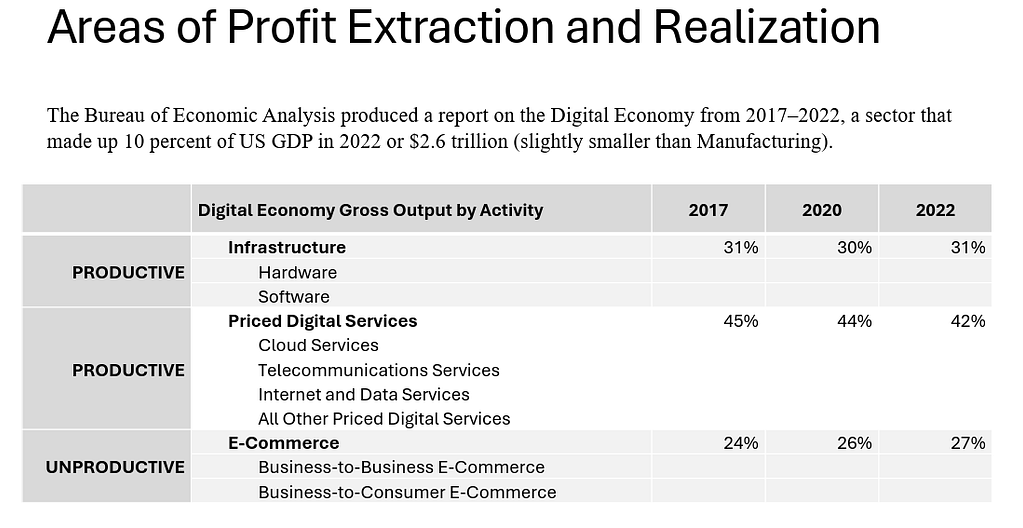
Recently, Norris & Espinoza (2026) , in a paper titled “A Marxian Political Economy of Big Tech and AI: Profits vs. Rents,” refute the idea that the political economy of “Big Tech” (Big Tech) is an expression of some kind of “techno-feudalism”—that is, that its dynamics are based on rents rather than profits. Contrary to Varoufakis’s intuition, Norris and Espinosa conclude that the technology sector actually generates more value than other sectors, as it is “more labor-intensive than many others” and, therefore, has a lower-than-average organic composition of capital.
Gráfica 1. Áreas de extracción y realización de la ganancia
Fuente: Norris & Espinoza (2026)
Gráfica 2. Big Tech en Software y Servicios de nube
Fuente: Norris & Espinoza (2026)
Fuente: Norris & Espinoza (2026)
Gráfica 2. Big Tech en Software y Servicios de nube
Fuente: Norris & Espinoza (2026)
In short, the technology sector “produces value, not rent” through computing and communication, logistics, and transportation—all of which are essential processes within the current stage of capitalism. Moreover, one of the theoretical conclusions of this study—conducted by independent researchers in the technology field based on robust empirical evidence—is that “(…) the creation and extraction of value in the digital economy follow the dialectic of Marx’s labor theory of value” (Norris & Espinoza, 2026, p. 2) .
IV. THE MYSTERY BEHIND “TECHNOFEUDALISM”: Neoliberalism Today
(…) the abstract thinker, in his contemplation of nature, learns that the beings he wanted to create out of nothing—out of pure abstraction, out of divine dialectics—as pure products of the work of thought that sways within itself and never turns toward reality, are nothing other than abstractions of natural determinations…. He analyzes these and those abstractions anew. His contemplation of nature is nothing more than the act of confirming his abstraction from the contemplation of nature—the generative act, consciously repeated by him, of his abstraction.
K. Marx, Economic and Philosophical Manuscripts of 1844
Despite its socio-historical implausibility and the theoretical (as well as methodological) inconsistencies we have already pointed out in Varoufakis’s proposal, the “techno-feudal thesis” has been received with renewed and relative fervor among various analysts. And although the “feudal perspective” is far from being a novel approach, since it is a body of literature that has been explored for at least three decades and continues to raise suspicions about its soundness—being a particularly weak, ambiguous approach—many contemporary writers insist on observing the final transition from capitalism toward a supposed phase now selectively labeled as neo-feudalism (see Costa, 2026) . In support of this emerging trend, some anti-colonial Marxist thinkers—among them, Ramón Grosfoguel—endorse the techno-feudal perspective, considering it “useful” for uncovering the status quo of contemporary society.
As analyzed earlier, techno-feudalism not only fails due to its lack of comprehensiveness (or grasping the essence of current reality), but it is also frustrating in terms of its explanatory potential, as it offers neither a credible empirical (historical) nor theoretical analytical foundation. Nevertheless, one question remains to be resolved on this matter: What, then, is the mystery behind this erratic label? Why does it emerge in the midst of the chronic crisis currently afflicting the prevailing social system, tempting us to embrace its ravings?
It’s not neo-feudalism. It’s neoliberalism, stupid!
If thinkers fascinated by techno-neo-feudalism had simply adopted a critical perspective—in the radical sense of this adjective (“To be radical is to attack the problem at its root. And the root, for man, is man himself,” as Marx said—on actually existing capitalism, and above all had adopted a consistent approach to the manifestations that are evident today within the current neoliberal phase, all these delusions—“hypotheses” and “theses”—would have dissipated, ruling them out outright. Maher (2026), for example, has put it simply and clearly: it is not neo-feudalism; it is hypercapitalism. To align with the essence of this insight—which would be best left as a straightforward statement of common sense—one need not even add any further prefixes. Here, however, it would be crucial to agree that, under a minimal definition of neoliberalism, this would be the historical social moment in which capitalism is experiencing an exacerbation of its dynamics—levels never before seen in economic exploitation (the progressive and accelerated impoverishment and precariousness of workers), political domination (neo-fascism), and cultural oppressions in the form of discrimination based on class, gender (misogyny), ethnicity (xenophobia), age, etc.—but above all, a characteristic that must necessarily be addressed: the exacerbation (almost irresistible, and therefore chronic) of all its contradictions. The “hyper” to which Maher refers.
Various manifestations of “actually existing” capitalism—including neoliberalism, which is now fully entrenched—have been hastily and erratically interpreted as “unequivocal signs” of a new-old era. The techno-neo-feudalists—acting in a haphazard and disorganized manner and suffering from severe deficits in imagination (starting with sociological imagination, as Wright Mills would surely say)—anticipate a “techno-return” without understanding that the signs they have selected with bias are not such a return, but rather authentic symptoms of this capitalist era. The anxious call for a “return” would obscure the fact that these striking neoliberal developments signify precisely the opposite: an advance—even amid its own degradation—of capitalist society and of no other. The techno-neo-feudalists have erred by confusing the socioeconomic debate—certainly a crucial one—on rent in capitalism (clarified
in a previous analysis), but they have also inappropriately conflated and distorted various phenomena that are part of the neoliberal advance or simply the form of neoliberalism prevalent today.
For example, it would be impossible to conclude that the particular obsession with COSPLAY (Costume Play)—reenactments of fictional roles that evoke and recreate medieval times—on the part of various groups sympathetic to neoliberal theses, especially in the circles of so-called alt-right libertarianism, could even suggest a connection to the actual social (re)construction of a contemporary “new feudalism.” In Crack-up capitalism. Market radicals and the dream of a world without democracy (2023), Slobodian devotes a chapter to this issue: “The Cosplay of the New Middle Ages,” noting that:
(…) In political discussions, “cosplay” is sometimes used as a derisive term for a type of politics that is escapist and unengaged with the real world. But as Friedman himself points out, his own response to the Middle Ages is unique in that it is real. You wear period clothing, you get blisters on your hands from the sword, you prepare and eat medieval food. In the same way, the historical LARPing of anarcho-capitalists had real-world results. They invite us to speculate, but to do so concretely, to really play the part (Slobodian, 2023).
It is true that this recreational fetish for the Middle Ages—visibly led by Milton Friedman’s son, David Director Friedman—has been a frequent and relatively widespread practice in various circles across the United States over the past few decades through what is known as Live Action Role-Playing (LARPing). Beyond being a mere role-playing game, cosplay and LARPing carry political significance within what neoliberals have elevated to a “countercultural war.” However, no mindset could possibly conceive of a “New Medieval World”—literally speaking—and beyond being an exclusively rhetorical device, it is never a cliché.
The same would hold true for the nostalgia felt by more than a few neoliberal “dealers in ideas” (as Hayek himself called them) regarding the (political) “virtues” of feudalism—and even the wistful longing they always emphasize for the supposed “good old days” of the Ottoman Empire— for, from Gordon Tullock to David Friedman, this would be the framework that would definitively bring about an “anarcho-capitalist,” “poly-legal” [sic] and “polyarchy” world (see Friedman, D., 1978); ultimately, the realization of the Hayekian dystopia centered on “demarchy”—the distortion of liberal democracy in the vein of neoliberalism.
In fact, the very idea of governance—which today permeates everyday language in various forms and expressions and seems to be quite widespread, even when used unconsciously—is a pseudo-concept that, with much confusion stemming from the actual and effective history of the Middle Ages, Hayek and Coase revived (and distorted) in their time, using the modalities of medieval government as a reference—that is, in their ambiguous terms, in the “image and likeness” of a strongly class-based state and a deeply stratified and unequal society—which they viewed as a highly productive paradigm to introduce (or, more accurately, to embed) within the framework of a progressively neo-liberalized society. The term “governance,” in fact, has become fashionable to refer—consciously and, worse still, unconsciously—to the desirable type of neoliberal political command, that is, one aligned with the reconstitution of market logics within the institutional governance of nation-states, including the dimension of “public” policies (ultimately, gradually public-private) to guarantee (impose) the decisions and interests of transnational capital in national spheres that should progressively be subjected to denationalization.
The mystery behind all these delusions, however, may not be so delusional after all.
Techno-and-neo feudal theories have overinterpreted and misinterpreted a specific reconfiguration that is today not only rampant but also prevalent in contemporary capitalism. The fusions and confusions surrounding techno/neo-feudalism failed to recognize the fact that today’s neoliberalism is advancing and deepening around what Slobodian aptly labels “Zones,” which directly constitute “states of exception” within the historical framework of capitalist nation-states (without the latter disappearing, as they are merely reconfigured) and which can also be referred to as “Silicon Valley-style” (neo)colonialism.
Therefore,
(…) we make a mistake if we see the world only in this jigsaw of nations. In fact, as scholars remind us, the modern world is pockmarked, perforated, tattered and jagged, ripped up and pinpricked. Inside the containers of nations are unusual legal spaces, anomalous territories, and peculiar jurisdictions. There are city-states, havens, enclaves, free ports, high-tech parks, duty-free districts, and innovation hubs. The world of nations is riddled with zones—and they define the “politics of the present in ways we are only starting to understand (Slobodian, 2023, p. 2)
In these terms: what is a “zone”?
At its most basic, it is an enclave carved out of a nation and freed from ordinary forms of regulation. The usual powers of taxation are often suspended within its borders, letting investors effectively dictate their own rules. The zones are quasi-extraterritorial, both of the host state and distinct from it. Zones come in a bewildering range of varieties—at least eighty-two, by one official reckoning
(Slobodian, 2023, p. 2)
Of course, if we turn to a visual representation of this issue (for example, the interactive portal—which offers this option; see Figure 1), we might be tempted to observe—especially with a Eurocentric mindset that is particularly uncritical of the dialectics of actual history—a world-image that, only on the surface, could be likened to medieval “fiefdoms.” However, in reality, this is a phenomenon specific to late capitalism and fully neoliberal capitalism.
Today there are at least 6,000 neoliberal zones or “micro-orders” around the globe, and most of them are located in Asia, Latin America, the Caribbean, and Africa; half are in China, and just over 10% are in the countries of central capitalism. If you will, as Slobodian himself points out, it is the inversion of Che Guevara’s phrase (to create “two, three Vietnams”), although now, inspired by the Mont-Pèlerin Society’s praise of “Milton’s paradise” (Friedman)—encouraged by the Mont Pèlerin Society to bring about “two, three, thousands of Hong Kongs”—the original vision that gave rise to this concept in neoliberalism (see Peck, 2021) .
In fact, the very idea of governance—which today permeates everyday language in various forms and expressions and seems to be quite widespread, even when used unconsciously—is a pseudo-concept that, with much confusion stemming from the actual and effective history of the Middle Ages, Hayek and Coase revived (and distorted) in their time, using the modalities of medieval government as a reference—that is, in their ambiguous terms, in the “image and likeness” of a strongly class-based state and a deeply stratified and unequal society—which they viewed as a highly productive paradigm to introduce (or, more accurately, to embed) within the framework of a progressively neo-liberalized society. The term “governance,” in fact, has become fashionable to refer—consciously and, worse still, unconsciously—to the desirable type of neoliberal political command, that is, one aligned with the reconstitution of market logics within the institutional governance of nation-states, including the dimension of “public” policies (ultimately, gradually public-private) to guarantee (impose) the decisions and interests of transnational capital in national spheres that should progressively be subjected to denationalization.
The mystery behind all these delusions, however, may not be so delusional after all.
Techno-and-neo feudal theories have overinterpreted and misinterpreted a specific reconfiguration that is today not only rampant but also prevalent in contemporary capitalism. The fusions and confusions surrounding techno/neo-feudalism failed to recognize the fact that today’s neoliberalism is advancing and deepening around what Slobodian aptly labels “Zones,” which directly constitute “states of exception” within the historical framework of capitalist nation-states (without the latter disappearing, as they are merely reconfigured) and which can also be referred to as “Silicon Valley-style” (neo)colonialism.
Therefore,
(…) we make a mistake if we see the world only in this jigsaw of nations. In fact, as scholars remind us, the modern world is pockmarked, perforated, tattered and jagged, ripped up and pinpricked. Inside the containers of nations are unusual legal spaces, anomalous territories, and peculiar jurisdictions. There are city-states, havens, enclaves, free ports, high-tech parks, duty-free districts, and innovation hubs. The world of nations is riddled with zones—and they define the “politics of the present in ways we are only starting to understand
(Slobodian, 2023, p. 2)
In these terms: what is a “zone”?
At its most basic, it is an enclave carved out of a nation and freed from ordinary forms of regulation. The usual powers of taxation are often suspended within its borders, letting investors effectively dictate their own rules. The zones are quasi-extraterritorial, both of the host state and distinct from it. Zones come in a bewildering range of varieties—at least eighty-two, by one official reckoning
(Slobodian, 2023, p. 2)
Imagen 1. Open Map Zone
It should be noted that the Zones are neither a strange nor, much less, a cryptic emerging phenomenon. Identifying them was not an intellectual odyssey; one simply needed the appropriate and relevant theoretical lens.
In their less elaborate forms, these “special” zones—and it is worth noting that they are not limited to “commercial” or exclusively “economic” dynamics, as they also involve political, cultural, and other issues—are (re)shaping the architecture of neoliberalism. For example, the (formerly so-called) “Free Trade Agreements” or the “Promotion Agreements” currently in vogue, as well as the transatlantic or transpacific schemes (supposedly on hold, since all of them continue “by other means”) in no way support—on the contrary, they disprove—the notion that visions of a virtual deglobalization or a return to “protectionist” regimes have any degree of economic plausibility or political meaning. Beneath the increasingly unexpected variety of all these formats, what is indeed evident (unfortunately) is the deepening of capitalist (il)logics and, especially, of neoliberal contradictions in today’s world, with no prospect of a neo-techno-feudal return.
To overcome the social Holocaust (as M. Max Neef put it) caused by neoliberal capitalism, we therefore need analyses that are committed not only to rigor—scientific, intellectual, and academic—but also to (political) conviction, if the goal is to propose real and effective alternative paths that are now imminent and particularly urgent.
References
AA. VV. (1980). La segunda servidumbre en Europa central y oriental. Akal.
Caffentzis, G. (2022). Una teoría marxista del valor-trabajo a la luz de la industria petrolera. Tinta Limón. (Obra original publicada en 2017, Autonomedia)
Costa, M. (2026). Mother of Capital. How rent gave birth to modernity. Pluto.
Diesen, G. (2025, septiembre 25). Tecno-feudalismo: ¿El fin del capitalismo? [Video recording]. https://www.youtube.com/watch?v=uuk5xwgmwpo
Durand, C. (2021). Tecnofeudalismo. Crítica de la economía digital. Kaxilda.
Durand, C. (2025, febrero 3). Desborde reaccionario del capitalismo: La hipótesis tecnofeudal [Nueva Sociedad]. https://www.nuso.org/articulo/315-desborde-reaccionario-del-capitalismo-la-hipotesis-tecnofeudal/
Dussel, E. (1988). Hacia un Marx desconocido. Un comentario a los Manuscritos del 61-63 (2013a ed.). Docencia.
Maher, S. (2026, mayo 25). It’s Not Neofeudalism, It’s Hypercapitalism. Jacobin. https://jacobin.com/2026/05/neofeudalism-hypercapitalism-tech-production-economy
Marx, C. (1857). Introducción general a la Crítica de la Economía política / 1857. Siglo XXI.
Marx, K. (1867). El Capital. Crítica de la economía política (1976a ed.). Akal. (Obra original publicada en 1867)
Marx, K. (1879). Comunidad, nacionalismos y capital. Textos inéditos (2018a ed.). Amauta Insurgente.
Norris, A. K., & Espinoza, T. (2026, enero 3). A Marxian Political Economy of Big Tech and AI: Profits vs. Rents. American Economic Association. Heterodox Perspectives on Technology, AI, and Digital Capitalism.
Peck, J. (2021). Milton’s paradise. Situating Hong Kong in Neoliberal lore. Journal of Law and Political Economy, 1(2).
Proudhon, P. J. (1863). The Federative Principle and the Need to Reconstitute the Party of Revolution. Marxist. https://www.marxists.org/reference/subject/economics/proudhon/1863/the-federative-principle.html
Slobodian, Q. (2023). Crack-up capitalism. Market radicals and the dream of a world without democracy. Metropolitan books.
Varoufakis, Y. (2024a). Tecno-feudalismo. El Sigiloso sucesor del capitalismo. Deusto.
Varoufakis, Y. (2024b, julio 14). El auge del tecnofeudalismo [Entrevista]. https://jacobinlat.com/2024/07/el-auge-del-tecnofeudalismo/
Varoufakis, Y. (2025a, enero 4). Star Trek: A humanist communist manifesto for our times. Thoughts for the post-2008 world. https://www.yanisvaroufakis.eu/2025/01/04/star-trek-a-humanist-communist-manifesto-for-our-times-unherd/
Varoufakis, Y. (2025b, enero 27). What Comes After Capitalism (Yascha Mounk) [Persuasion]. https://www.persuasion.community/p/yanis-varoufakis-on-what-comes-after
José Francisco Puello-Socarrás es Politólogo de la Universidad Nacional de Colombia, Máster en Administración Pública y Doctorante en Ciencia Política.
Docente y educador en la Escuela de Administración Pública y la Universidad Nacional de Colombia.
Autor de Nueva Gramática del Neo-liberalismo, Política: Mito, Filosofía y Ciencia, La Izquierda en los Tiempos de las Cóleras entre otros.
This essay aims to critically unravel the particularities of the expression ‘technofeudal’—both from its intended role as an analytical category and from its elevation to a supposed ‘theory’ that, according to its creator and stealthy followers, would be useful not only to reliably describe the current economic-political moment of global capitalism, but also as a solid framework that would make it possible to ‘forecast’ (or ‘predict’?) the features of, and the transition toward, a new post-capitalist society in the near future.
Este ensayo apunta a desentrañar críticamente las particularidades de la expresión “tecnofeudal” tanto desde su pretendido carácter de categoría analítica como también de su elevación a una supuesta “teoría” que —según su propio creador y sus sigilosos seguidores— sería útil no solo para describir con verosimilitud el actual momento económico-político del capitalismo mundial, sino también en tanto una construcción sólida que permitiría “pronosticar” (¿”predecir”?) los rasgos y el trance hacia nueva sociedad pos-capitalista en el futuro próximo.
FORMA PARTE DE LA COMUNIDAD #POLITICSAPIENS EN FACEBOOK
SUSCRÍBETE a las publicaciones
PRESIONA ▶ PARA ESCUCHAR ESTE ARTÍCULO
ÚNETE! SÉ UN
#PoliticSapiens
Mantente
informado de Política de Nuestra América
Al unirte aceptas la Política de Privacidad: trataremos tus datos con respeto con el fin de informarte, para que puedas expresarte con libertad y así mismo pienses.